World Chess Championship 2026 Prize Fund, Rules, Time Control and Tiebreaks
How much money is at stake in Geneva, how is it shared, and what are the rules of Gukesh vs Sindarov? Everything below comes from FIDE’s official Regulations for the FIDE World Championship Match 2026, explained in plain English, with worked prize examples.
Prize fund: how the money is shared
The total prize fund is US$2,500,000, net of any local taxes [4.5.1]. It is not a simple “winner takes most” prize. The split depends on how many games each player wins [4.5.2]:
- Normal case: each player gets US$200,000 for every classical game he wins (a win by forfeit counts too). Whatever is left is split equally between the two players.
- Very close finish: if the final score is 7½–6½ with 13 decisive games, or 8–6 with all 14 games decisive, the winner gets US$1,300,000 and the runner-up US$1,200,000.
- Tiebreak finish: if the match is decided in the tiebreaks, it is also US$1,300,000 to the winner and US$1,200,000 to the runner-up.
- Payment: each player receives US$200,000 of the fund one month before game 1. The rest is paid within 30 working days after the match [4.5.3].
So every win is worth real money, but a match with many draws leaves the two players with similar amounts.
Prize money examples
Here is what the rule gives in five possible finishes. These are worked examples, not predictions. The two shares always add up to US$2,500,000.
| Example | Final score | Games won (winner – loser) | Winner gets | Loser gets |
|---|---|---|---|---|
| Close match, 14 games | 7½–6½ | 3 – 2 (9 draws) | US$1,350,000 | US$1,150,000 |
| Clear win after 12 games | 7½–4½ | 4 – 1 (7 draws) | US$1,550,000 | US$950,000 |
| Very one-sided, 8 games | 7½–½ | 7 – 0 (1 draw) | US$1,950,000 | US$550,000 |
| Almost no draws, 14 games | 7½–6½ | 7 – 6 (1 draw) | US$1,300,000 | US$1,200,000 |
| 7–7, decided in tiebreaks | 7–7 + tiebreak | 2 – 2 (10 draws) | US$1,300,000 | US$1,200,000 |
How the first line is worked out: the winner won 3 games (US$600,000) and the loser 2 (US$400,000). That leaves US$1,500,000, split US$750,000 each. Totals: US$1,350,000 and US$1,150,000. Source: regulations article 4.5.2.
Match format
- 14 classical games at most [4.1].
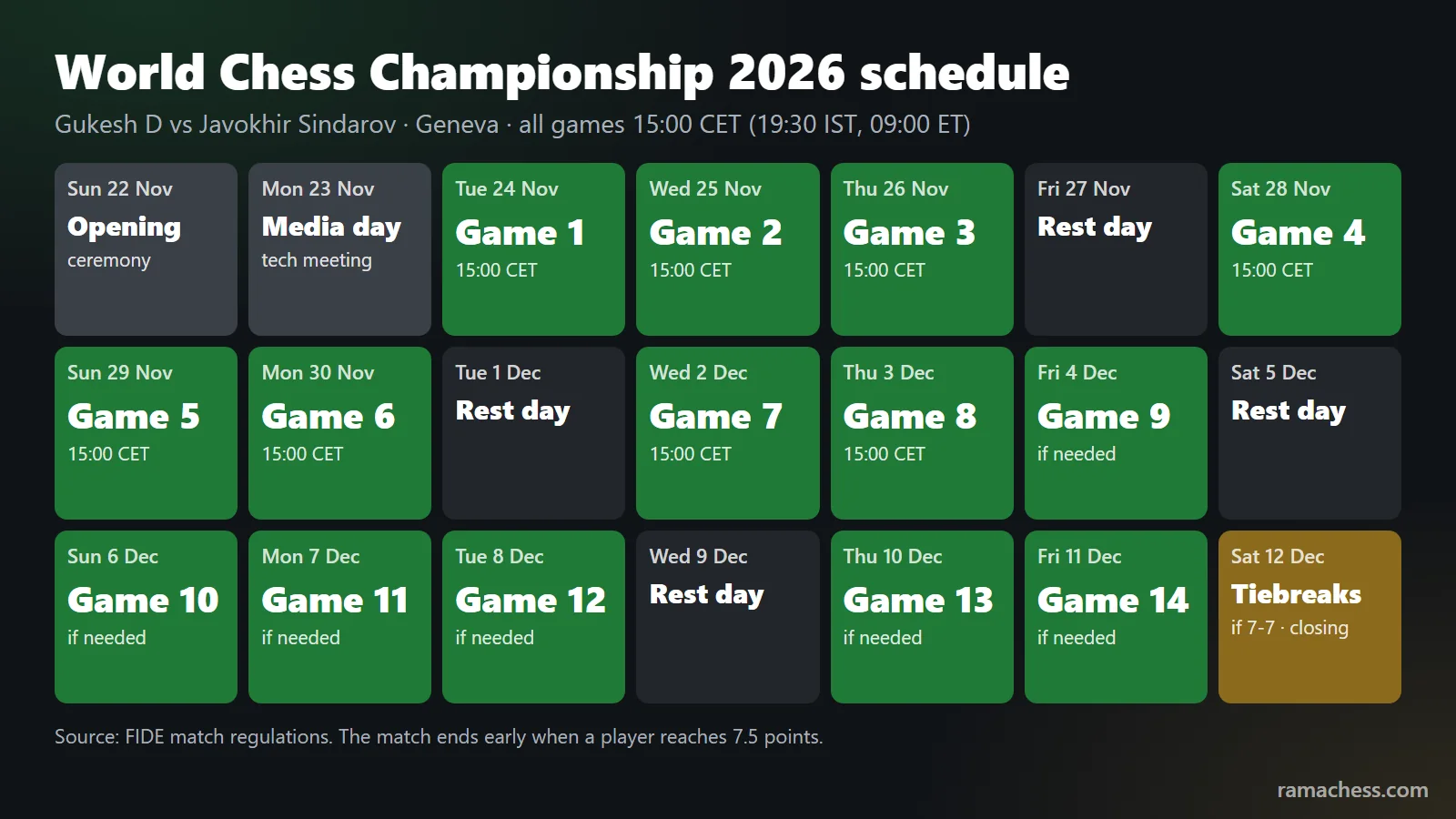
- The player who reaches 7½ points wins the title, and no further games are played [4.4.1]. That can happen as early as game 8.
- If the score is 7–7 after 14 games, tiebreaks decide the title.
- Colours are drawn at the opening ceremony on 22 November. The player with White in game 1 has White in every odd-numbered game [4.9].
- The match schedule has a rest day after every three games, and no game can be postponed [4.6.2]. Only the FIDE President can approve a schedule change [4.6.3].
Every date and start time, in IST, CET and US time zones, is on the full schedule page.
Time control
Each player has 120 minutes for the first 40 moves, then 30 minutes for the rest of the game, with an increment of 30 seconds per move starting from move 41 [4.2.2]. There is no increment for the first 40 moves. The games are played on electronic boards with electronic clocks approved by FIDE [4.2.1].
No early draws
The players cannot agree a draw before Black’s 40th move [4.3]. Before that point a game can end in a draw only by threefold repetition or stalemate, and the draw has to be claimed through the Chief Arbiter or the deputy. This rule stops quick “handshake” draws.
What happens at 7–7: the tiebreaks
If the classical games end level, the tiebreaks are played on Saturday 12 December 2026. Each stage starts only if the previous one is still level, and lots are drawn again for colours before each stage [4.4.2]:
- Four rapid games, 15 minutes + 10 seconds per move.
- Two rapid games, 10 minutes + 5 seconds per move.
- Two blitz games, 3 minutes + 2 seconds per move.
- Single blitz games, 3 minutes + 2 seconds, with colours reversed after each draw, until one game is won.
There is no Armageddon game. There is a 10-minute pause between tiebreak games unless the Chief Arbiter decides otherwise [4.4.2.9]. The start time of the tiebreak day is not announced yet: the regulations list it as “TBD”. The last world title match decided in tiebreaks was in 2023, when Ding Liren beat Ian Nepomniachtchi in rapid games – see our history page.
Rules for the players at the board
- Zero tolerance for lateness: a player who reaches the playing area after the actual start time loses the game [4.2.3]. Players must arrive at least 10 minutes early for a security check [4.10.4].
- No phones or electronic devices in the playing area [4.10.5]. Breaking these rules can cost a fine of up to US$10,000 [4.10.7].
- Fair play: FIDE applies its anti-cheating measures for events that need “maximum protection” [4.10.1].
- Leaving the venue during a game is allowed only with the Chief Arbiter’s permission and with an arbiter [4.10.6].
- Dress code: a neat shirt and a formal suit [4.12.1].
- Press conference after every game, of up to 30 minutes [4.12.5].
- Protests go to an Appeals Committee and cost a US$3,000 deposit, returned if the protest is accepted [4.15.2].
- Replacement: if the champion or the challenger withdraws, Anish Giri (Candidates runner-up) takes his place, then Fabiano Caruana (third) [2.2–2.3].
Venue and key dates
The match is played at the Fondation Martin Bodmer in Cologny, Geneva, Switzerland. The title sponsor is Salesforce. Players arrive on 20 November; the opening ceremony and drawing of colours is on 22 November; game 1 is on Tuesday 24 November at 15:00 CET (19:30 IST, 09:00 ET); game 14 is on 11 December; tiebreaks and the closing ceremony on 12 December [4.6.1]. To follow the games, see how to watch live. To learn about the challenger, read who is Javokhir Sindarov.
Frequently asked questions
What is the prize fund of the World Chess Championship 2026?
US$2,500,000, net of local taxes, provided by the organiser (FIDE regulations, article 4.5.1).
How much does the winner of the World Chess Championship 2026 get?
It depends on how many games each player wins. Each player gets US$200,000 for every classical game he wins and the rest is shared equally. In a very close finish (7½–6½ with 13 decisive games, or 8–6 with 14 decisive games) or a tiebreak finish, the winner gets US$1,300,000 and the loser US$1,200,000.
How many games are in the World Chess Championship 2026?
Up to 14 classical games. The first player to reach 7½ points wins and the remaining games are not played. The earliest possible finish is game 8.
What is the time control?
120 minutes for the first 40 moves, then 30 minutes for the rest of the game, with 30 seconds added per move from move 41.
Can the players agree a draw?
Not before Black’s 40th move. Before that, a game can only be drawn by threefold repetition or stalemate, and the claim goes through the Chief Arbiter or the deputy.
What happens if the score is 7-7?
Tiebreaks on 12 December: four rapid games (15 minutes + 10 seconds), then two rapid games (10 + 5), then two blitz games (3 + 2), then single blitz games (3 + 2) with colours reversed after each draw, until one player wins a game.
Is there an Armageddon game?
No. The regulations have no Armageddon. If the blitz games are still level, single 3 + 2 games are played one after another until one of them has a winner.
What time do the tiebreaks start?
Not announced yet. The FIDE regulations list the tiebreak time as “TBD”, and we had not seen an official start time when we checked on Thursday 12 November 2026.
What happens if a player is late?
He loses the game. A player who reaches the playing area after the actual start time loses by default, so there is no grace period. Players must arrive 10 minutes early for the security check.
Who replaces a player who withdraws?
Anish Giri, the runner-up of the 2026 Candidates. If another replacement is needed, Fabiano Caruana, who finished third.
More on the 2026 match
ramachess.com · World Chess Championship 2026 · Chess news · Games with commentary · Play chess bots