Budapest Gambit Traps: 5 Real Traps for Black and White
The Budapest Gambit, 1.d4 Nf6 2.c4 e5, is a sharp answer to 1.d4. Black gives the e5 pawn and tries to win it back with the knight. Many players on both sides lose in the first ten moves. This page has five real traps. Three are for Black: the Kieninger Trap, the Fajarowicz trap and a mate on d3 in the Fajarowicz. Two are Budapest Gambit traps for White, where a natural Black move loses a piece. Each trap is on its own board with the side lines, a Stockfish evaluation and a short "how to avoid it".
9 min readPublished November 2026By Surajit Paul5 traps · 5 boards
There is no Budapest Gambit video on our channel yet, so here is our general opening traps video: Stockfish 18 shows six traps every club player should know. Then replay the five Budapest traps below at your own speed.
Stockfish 18 Shares 6 Chess Opening Traps That You Must Know | Chess Opening
How to use the boards: press ▶ Play or tap a move. The buttons above each board switch to the side lines (what if the other player plays something else). Arrows show the threats; draw your own with a right-click drag. The numbers are Stockfish 18 evaluations: + means White is better, - means Black is better.
Budapest Gambit traps for Black
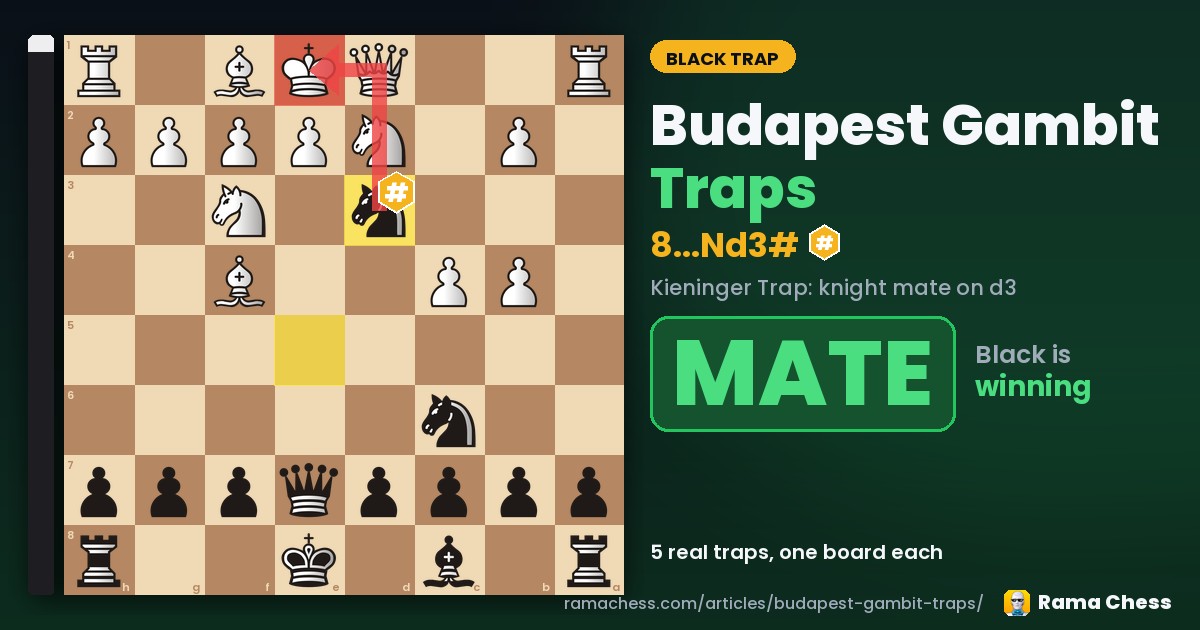
All three Black traps end with a piece landing on a square White did not watch. Two of them end in the same mate: a knight on d3, with the e2 pawn pinned by the queen on e7. That is the main pattern to learn in the Budapest.
BLACK TRAPTrap 1: The Kieninger Trap
1.d4 Nf6 2.c4 e5 3.dxe5 Ng4 4.Bf4 Nc6 5.Nf3 Bb4+ 6.Nbd2 Qe7 7.a3White falls for it with 8.axb4??8...Nd3# - checkmate on move 8
The most famous Budapest Gambit trap. Black wins back the e5 pawn with 7...Ngxe5 and leaves the bishop on b4 to be taken. If White takes it, a knight check on d3 is mate, because the e2 pawn is pinned. Press Play, then try the side lines.
How to avoid it: as White, after 7...Ngxe5 take the knight first with 8.Nxe5 Nxe5 and then play 9.e3. Do not take on b4 while the black queen is on e7 and a black knight can reach d3.
BLACK TRAPTrap 2: The Fajarowicz Trap (6.g3?? Nxf2!)
1.d4 Nf6 2.c4 e5 3.dxe5 Ne4 4.Nf3 d6 5.exd6 Bxd6White falls for it with 6.g3??6...Nxf2! and 7...Bxg3+ wins the queen
In the Fajarowicz Variation the knight goes to e4. After 4...d6 5.exd6 Bxd6 the black bishop hits g3 and the queen looks down the open d-file. If White plays the natural 6.g3, Black sacrifices on f2 and wins the white queen. Press Play.
How to avoid it: as White, after 5...Bxd6 play 6.Nbd2 and hit the e4 knight. Do not play g3 while a black bishop sits on d6 and the d-file is open. If you already played 6.g3 and Black takes on f2, play 7.Qd4!: you lose the rook on h1, not the queen.
Advertisement
BLACK TRAPTrap 3: Mate on d3 in the Fajarowicz (4.Qc2)
1.d4 Nf6 2.c4 e5 3.dxe5 Ne4 4.Qc2 Bb4+ 5.Nd2 d5 6.exd6 Bf5White falls for it with 7.Qa4+? and 10.Qd1??10...Nd3# - checkmate on move 10
A short game that shows the same mate as the Kieninger Trap. White chases the knight with 4.Qc2, then goes pawn-hunting with the queen. Black brings the queen to e7, the e2 pawn is pinned, and the knight mates on d3. Press Play.
How to avoid it: as White, after 6...Bf5 play 7.a3 and the game is level. Do not take a third pawn with dxc7 while your king is still in the centre, and never leave d3 to a black knight when the e2 pawn is pinned.
Budapest Gambit traps for White
The White traps punish Black for hurrying. In the Budapest Gambit Black wants the e5 pawn back, and in both traps Black reaches for it (or for a quick check) one move too early. Stockfish gives White a whole piece in both lines.
WHITE TRAPTrap 4: Taking back on e5 too early (Rubinstein Variation)
1.d4 Nf6 2.c4 e5 3.dxe5 Ng4 4.Bf4 Nc6 5.Nf3 Bb4+ 6.Nbd2Black falls for it with 6...Ngxe5?8.Bxe5 - White wins a knight
A Budapest Gambit trap for White. Black wants the e5 pawn back at once. But e5 is hit twice and guarded twice, and taking it now simply loses a knight. This is why Black plays 6...Qe7 first in the Kieninger line. Press Play.
How to avoid it: as Black, count the attackers before you take on e5. In the Rubinstein Variation play 6...Qe7 first, and only then ...Ngxe5.
WHITE TRAPTrap 5: The ...Qh4+ check in the Alekhine Variation
1.d4 Nf6 2.c4 e5 3.dxe5 Ng4 4.e4 Nxe5 5.f4Black falls for it with 5...Qh4+?6.g3! - the queen and the knight are both hit
Another Budapest Gambit trap for White. White chases the knight with 5.f4, and the queen check on h4 looks like it wins. But 6.g3 blocks the check and hits the queen, and the knight on e5 is still attacked. Black cannot save both. Press Play.
How to avoid it: as Black, after 5.f4 move the knight back with 5...Nec6 (or 5...Ng6). A check is only good if it also does something.
Where the Budapest Gambit and its traps come from
The first known game with 2...e5 was a casual game between Mór Adler and Géza Maróczy in Budapest in 1896. Maróczy said the idea came from Zsigmond Barász, and István Abonyi and Gyula Breyer worked on it further. The gambit became famous in 1918, when Milan Vidmar used it to beat Akiba Rubinstein in 24 moves in Berlin.
The Kieninger Trap is named after the German player Georg Kieninger (1902-1975). The Fajarowicz Variation, 3...Ne4, carries the name of Fajarowicz: its first important game was H. Steiner vs Fajarowicz at the Wiesbaden tournament of 1928. Stockfish does not trust it: after the best moves White is clearly better. That is why it is played mainly as a surprise, for its traps.
How to play against the Budapest Gambit without falling into traps
Most Budapest Gambit traps use the same three ideas. Learn them and you are safe with either colour:
Watch the d3 square. When the black queen is on e7 and the white e2 pawn is still at home, a knight on d3 can be mate. Both the Kieninger Trap and Trap 3 end there.
Watch the d-file. After ...d6 and exd6 Bxd6 the black queen faces the white queen. One discovered check, like 7...Bxg3+ in the Fajarowicz trap, wins it.
Count before you take on e5. As Black, bring the queen to e7 first. As White, keep two pieces on e5 and wait for Black to grab too early.
The Kieninger Trap: 1.d4 Nf6 2.c4 e5 3.dxe5 Ng4 4.Bf4 Nc6 5.Nf3 Bb4+ 6.Nbd2 Qe7 7.a3 Ngxe5 8.axb4?? Nd3#. The e2 pawn is pinned by the queen on e7, so it cannot take the knight.
What is the Fajarowicz trap?
It comes from the Fajarowicz Variation, 3...Ne4. After 4.Nf3 d6 5.exd6 Bxd6 6.g3?? Nxf2! 7.Kxf2?? Bxg3+ the bishop gives check and the black queen takes the white queen on d1. Even after the best defence 7.Qd4, Black wins the rook on h1.
Are there Budapest Gambit traps for White?
Yes. Black often hurries to win the e5 pawn back. In the Rubinstein Variation 6...Ngxe5? loses a knight to 7.Nxe5 Nxe5 8.Bxe5, and in the Alekhine Variation 5...Qh4+? 6.g3! hits the queen and the knight at the same time.
Is the Budapest Gambit good?
It is playable but not fully sound. Stockfish gives White a small edge, about +0.8, after 3.dxe5 Ng4. The Fajarowicz 3...Ne4 is riskier: about +1.0 for White after 4.Nf3.
How do I avoid the Kieninger Trap as White?
After 7...Ngxe5 take the knight first with 8.Nxe5 Nxe5, then play 9.e3. Taking the bishop on b4 (on move 8 or 9) runs into ...Nd3 mate.
What should White play against the Budapest Gambit?
Simple development works well. In the Rubinstein Variation (4.Bf4) White guards e5 twice. In the Alekhine Variation (4.e4) White gives the pawn back for a big centre. Both give White a small, safe edge.
Set these traps in your own games
Play the Budapest Gambit against a bot and see who walks into the Kieninger Trap first.