Dutch Defense Traps: 4 Real Traps for White and Black
The Dutch Defence, 1.d4 f5, is a fighting answer to 1.d4. The move 1...f5 also opens the e8-h5 diagonal next to the black king, and most traps against the Dutch use it. This article has three Dutch Defense traps for White (two after 2.Bg5 and the best known Staunton Gambit trap) and one Dutch trap for Black. Each trap is on its own board with the side lines, a Stockfish evaluation and a short "how to avoid it".
7 min readPublished November 2026By Surajit Paul4 traps · 4 boards
This video from our channel is not about traps. It shows how a strong engine plays the Dutch Defence in a real game: Stockfish 15 against Dragon 3 in the Classical Dutch. Watch it, then replay each trap on the boards below.
How to use the boards: press ▶ Play or tap a move. The buttons above each board switch to the side lines (what if the other player plays something else). Arrows show the threats; draw your own with a right-click drag. The numbers are Stockfish 18 evaluations: + means White is better, - means Black is better.
Dutch Defense traps for White (traps against the Dutch)
All three traps against the Dutch use the same weak line: the diagonal from h5 to e8. The move 1...f5 opens it, and ...g5, ...g6 or a missing knight on f6 can leave it with no guard. Two traps come after 2.Bg5 (the Hopton Attack) and one after 2.e4 fxe4 3.Nc3 Nf6 4.Bg5 (the Staunton Gambit).
WHITE TRAPTrap 1: Qh5 mate after 2.Bg5 (Hopton Attack)
1.d4 f5 2.Bg5 h6 3.Bh4 g5 4.e4!?Black falls for it with 4...gxh4?? or 4...fxe4??5.Qh5# - mate on move 5
Black chases the bishop with ...h6 and ...g5. White does not move the bishop. After 4.e4 the queen can reach h5, and if Black takes anything the king is mated at once. Press Play, then try the side lines.
How to avoid it: as Black, after 4.e4 do not take anything. Play 4...Bg7 or 4...Nf6 and the game is about level. Before you take a free piece, look at the e8-h5 diagonal.
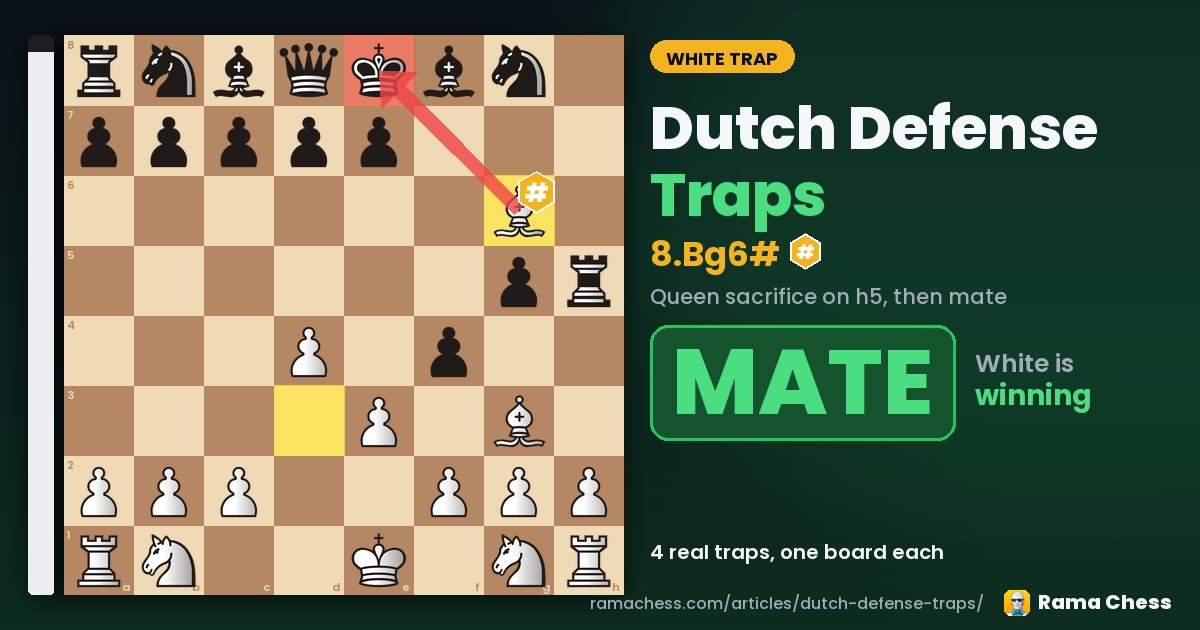
WHITE TRAPTrap 2: The Bg6 mate after 2.Bg5 h6 3.Bh4 g5 4.Bg3 f4
1.d4 f5 2.Bg5 h6 3.Bh4 g5 4.Bg3 f4? 5.e3 h5 6.Bd3Black falls for it with 6...Rh6??7.Qxh5+! Rxh5 8.Bg6# - mate
Black keeps pushing pawns at the bishop. Every pawn move leaves a light square weak. After 6.Bd3 White threatens Bg6+, and the natural guard 6...Rh6 allows a queen sacrifice and mate. Press Play.
How to avoid it: as Black, after 4.Bg3 play 4...Nf6 and develop. If you already played 4...f4 and 5...h5, answer 6.Bd3 with 6...d5 so the king can go to d7.
Advertisement
WHITE TRAPTrap 3: The Staunton Gambit trap (4...h6?)
1.d4 f5 2.e4 fxe4 3.Nc3 Nf6 4.Bg5 h6?Black falls for it with 5...gxf6??6.Qh5# - mate on move 6
In the Staunton Gambit White gives a pawn for quick development. The natural 4...h6 lets White take the f6 knight, the piece that guards h5. Then Qh5 comes with check, and taking back with the wrong pawn is mate. Press Play.
How to avoid it: as Black, after 4.Bg5 play 4...g6 or 4...c6, not 4...h6. If you already played 4...h6 and White takes on f6, take back with 5...exf6 and answer 6.Qh5+ with 6...Ke7.
A Dutch trap for Black
Black also has tricks. In the Staunton Gambit White wants the e4 pawn back, and the quick 5...Qa5 turns that wish into a lost piece.
BLACK TRAPTrap 4: A Dutch trap for Black in the Staunton Gambit (5...Qa5)
1.d4 f5 2.e4 fxe4 3.Nc3 Nf6 4.Bg5 c6 5.f3 Qa5White falls for it with 6.fxe4??6...Qxg5 - Black wins the bishop
A trap for Black. After 4...c6 the queen can come to a5. From there it pins the c3 knight and looks along the 5th rank at the g5 bishop. If White takes back the pawn with 6.fxe4, the bishop on g5 has no guard. Press Play.
How to avoid it: as White, after 5...Qa5 guard the bishop with 6.Qd2, or move it with 6.Bd2. Only take on e4 when g5 is safe. A queen on a5 always looks at c3 and the whole 5th rank.
Where the names come from
The Dutch Defence takes its name from Elias Stein, an Alsace-born player who settled in The Hague. In 1789 he recommended 1...f5 in his book Nouvel essai sur le jeu des échecs.
The Staunton Gambit, 1.d4 f5 2.e4, is named after Howard Staunton. He played it in his match against Bernhard Horwitz in London in 1846.
The Hopton Attack is the name for 1.d4 f5 2.Bg5. Other sharp tries against the Dutch are the Korchnoi Attack (2.h3 and 3.g4) and the Krejcik Gambit (2.g4).
How to play the Dutch without falling into traps
Every trap in this article uses the squares next to the black king. Three simple habits keep you safe as Black:
Watch the h5-e8 diagonal. After 1...f5 only a knight on f6 or a pawn on g6 can close it. Before you move that knight or that pawn, check Qh5+.
Do not chase a bishop with every pawn. In traps 1 and 2 the moves ...h6, ...g5, ...f4 and ...h5 win time but leave the light squares empty. Develop with ...Nf6 and ...Bg7 instead.
Count the guards before you take. In trap 1 the free bishop costs the game, and in trap 4 White loses a bishop by taking back a pawn too early.
For a quick win, 1.d4 f5 2.Bg5 h6 3.Bh4 g5 4.e4 is the shortest: if Black takes with 4...gxh4 or 4...fxe4, 5.Qh5 is mate. But it is a trap, not a strong move: after 4...Bg7 Stockfish gives White only +0.3.
What is the Staunton Gambit trap?
After 1.d4 f5 2.e4 fxe4 3.Nc3 Nf6 4.Bg5 h6? 5.Bxf6, the natural 5...gxf6?? loses to 6.Qh5 mate. Even the better 5...exf6 6.Qh5+ Ke7 leaves Black with a king in the centre, about +2.4 for White.
Is there a Dutch trap for Black?
Yes. In the Staunton Gambit, 4.Bg5 c6 5.f3 Qa5 pins the c3 knight and eyes the g5 bishop. If White plays 6.fxe4?? then 6...Qxg5 wins the bishop. The right answer for White is 6.Qd2 or 6.Bd2.
Is the Dutch Defense good for Black?
Yes, it is a sound opening and strong players use it. It is more risky than 1...d5 because 1...f5 weakens the king. Learn the e8-h5 diagonal and the traps on this page, and it is a good fighting choice.
How do I avoid traps in the Dutch Defence?
Develop the knight to f6 early and do not push ...g5, ...f4 and ...h5 just to chase a bishop. Before every move near your king, check whether a white queen on h5 would give mate.
Is the Staunton Gambit sound?
It is playable. Against the best defence, for example 4.Bg5 g6, Stockfish gives White only a small edge (about +0.15). It is a good surprise weapon because one natural move like 4...h6 already loses.
Set these traps in your own games
Play 1.d4 against a bot and see if it walks into Qh5 mate.