
Kasparov vs Deep Blue, Game 6 (1997): the Knight Sacrifice, Move by Move
On 11 May 1997, in the last game of their rematch, IBM's Deep Blue gave up a knight on move 8 against world champion Garry Kasparov. Replay the whole game below with Stockfish 19's commentary on every move, the arrows, an eval bar and 6 alternative variations, then read why 7...h6 opened the door and why Kasparov stopped after 19.c4.
Watch: Stockfish judges Deep Blue vs Kasparov, game 6
Watch Stockfish's video analysis of this game, then replay it yourself on the board below.
Replay Deep Blue vs Kasparov, game 6 with commentary
Step through the game with the buttons or the arrow keys. Every move has Stockfish 19's commentary, the eval bar shows who is better, and the arrows show the ideas. At a branch point the first press of Next shows the choices: 1 is the game, 2 and up are the alternative variations. Tap any move in the move list to jump there.
 Stockfish 19commentary
Game: Deep Blue (White) vs Garry Kasparov (Black), IBM rematch, New York, 11 May 1997, game 6. Caro-Kann Defence, Steinitz variation (B17). 1-0 in 19 moves.
Deep Blue vs Kasparov: the 1996 and 1997 matches
Kasparov and IBM's chess computer played two six-game matches. Kasparov won the first in Philadelphia in February 1996, 4-2, even though Deep Blue won game 1: the first game a computer won against a reigning world champion at a normal time control. For the rematch in New York in May 1997 Deep Blue was upgraded and about twice as fast.
| 1996 match | 1997 rematch | |
|---|---|---|
| Where | Philadelphia, Pennsylvania Convention Center | New York, Equitable Center |
| When | 10 - 17 February 1996 | 3 - 11 May 1997 |
| Games | 6 | 6 |
| Final score | Kasparov 4, Deep Blue 2 | Deep Blue 3.5, Kasparov 2.5 |
| Prize for the winner / loser | $400,000 / $100,000 | $700,000 / $400,000 |
| Deep Blue's speed | about 100 million positions a second | about 200 million positions a second |
Sources: Wikipedia "Deep Blue versus Garry Kasparov" and IBM's Deep Blue history page. More on both matches in our Deep Blue vs Kasparov article.
The 1997 rematch, game by game
| Game | White | Result |
|---|---|---|
| 1 | Kasparov | Kasparov won |
| 2 | Deep Blue | Deep Blue won |
| 3 | Kasparov | Draw |
| 4 | Deep Blue | Draw |
| 5 | Kasparov | Draw |
| 6 | Deep Blue | Deep Blue won in 19 moves |
Before game 6 the score was 2.5 - 2.5.
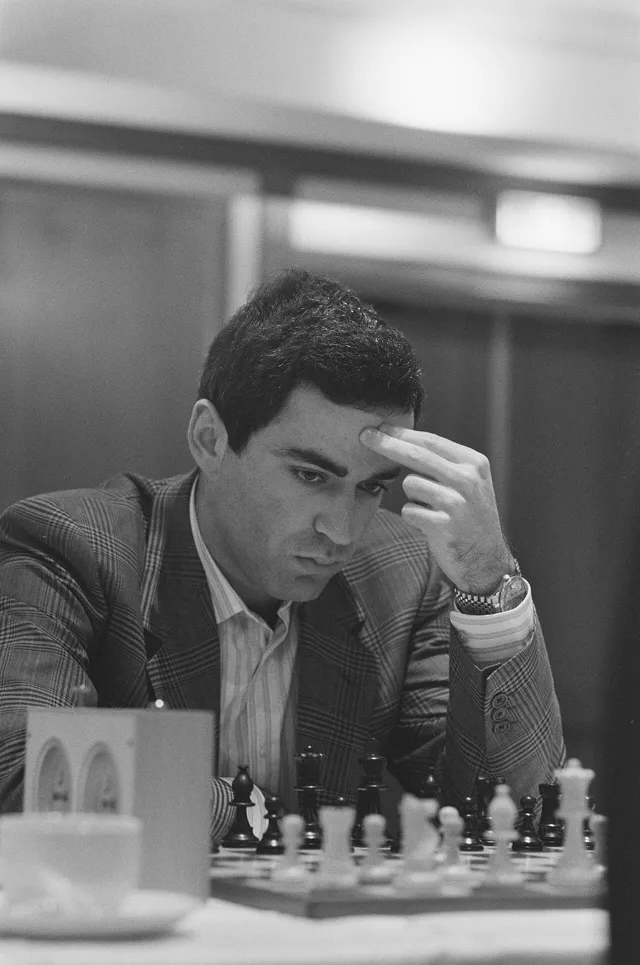
7...h6: why was it a mistake?
Short answer: 7...h6 kicks the knight on g5 but moves the pawn that guards g6, so after 8.Nxe6 fxe6 the bishop on d3 can check from g6 and Black's king is stuck in the centre. Opening books play 7...Bd6 first, so the h7 pawn is still there to take on g6.
Game 6 is a well-known Caro-Kann line: 4...Nd7 5.Ng5 Ngf6 6.Bd3 e6 7.N1f3. Here the usual move order is 7...Bd6, and only later ...h6. Kasparov played 7...h6 at once. Chess writers have long called it a known mistake in this position, because the knight sacrifice on e6 was already known to opening theory before 1997. Kasparov later said he had mixed up the move order. Step to move 7 on the board above: the commentary marks the hole on g6 and the check on e8.
More on this opening: our Caro-Kann guide and the Caro-Kann traps (the 5.Qe2 / 6.Nd6 mate from the same 4...Nd7 line is one of them).
8.Nxe6!!: why did Deep Blue give up a knight?
Short answer: for one pawn White gets an open e-file and the g6 square. After 8...Qe7 9.O-O fxe6 10.Bg6+ Kd8 11.Bf4 Black's king can never castle and never hide, and White's rook comes to e1 against the pinned e6 pawn.
The knight on e6 hits the queen on d8, the bishop on f8 and the g7 pawn. Kasparov did not take at once: 8...Qe7 pins the knight to the white king on e1. Deep Blue simply castled, and when Black took on move 9 the bishop came to g6 with check. From there Black's king is a target for the rest of the game: 11.Bf4 takes away c7 and b8, 13.Re1 lines up on the e-file, and 17.Bf5! hits the pinned e6 pawn again.
The board above shows the alternatives at the key moments: 4...Bf5 instead of 4...Nd7, 16...Nb4, three other replies to 17.Bf5 (17...Kb7, 17...Qf7 and 17...Qf6) and 18...Nxe7, which ends in a mate with 24.Qc7#. The eval bar (our Stockfish, worked out once for every position) goes from about +0.5 before 7...h6 to about +1 after it, and +1.7 once Black has played 8...Qe7.
Why did Kasparov resign after 19.c4?
Short answer: after 19.c4 material is roughly even, but Black's king on c8 has no shelter, the knight on d5 is attacked, and White's queen, rook and bishop all point at the king. After 19...bxc4 20.Qxc4 the queen joins with tempo, and 20...Kb7 would run into 21.Qa6 mate.
Count the pieces after 18.Rxe7 Bxe7 19.c4: Black has two rooks, two bishops, two knights and five pawns, White has queen, rook, bishop, knight and six pawns. On paper that is close to even. The problem is the king. 19.c4 hits b5 and d5, the queen eyes the loose f5 pawn, the bishop on g3 controls b8 and the rook on a1 looks down the open a-file. Kasparov resigned. It was the shortest game of either match.
Who won Deep Blue vs Kasparov 1997, and what came after?
Short answer: Deep Blue won the 1997 rematch 3.5-2.5, the first match a reigning world champion lost to a computer under standard time controls. Game 6 decided it.
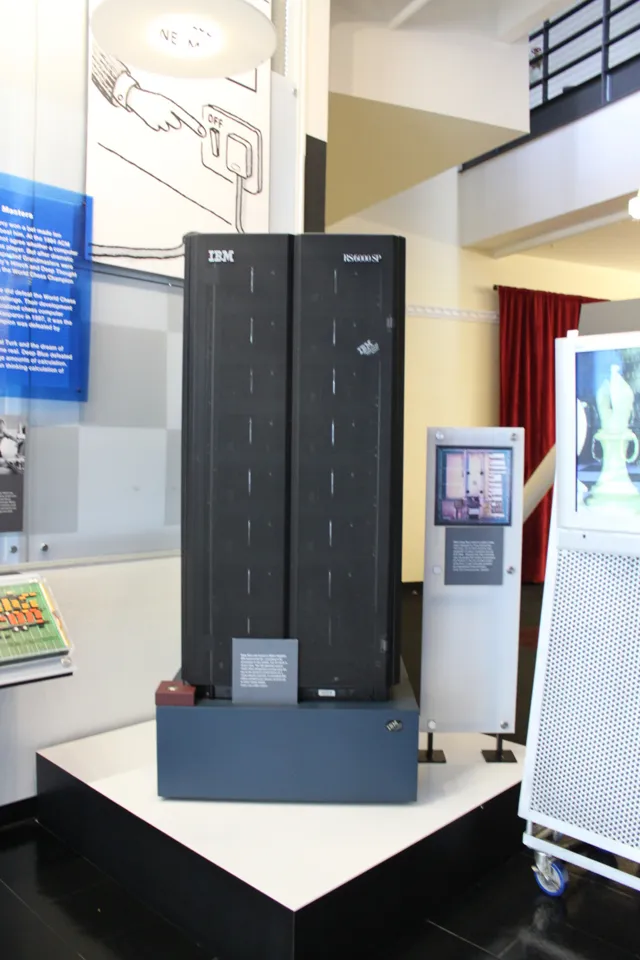
After the match Kasparov said he suspected outside human help, above all in game 2, and asked to see Deep Blue's logs. IBM denied any human help during the games, later published the logs, declined a third match and retired the machine. No proof of human help was ever found, and in later years Kasparov spoke of the match more calmly. One of Deep Blue's two cabinets is at the Smithsonian's National Museum of American History, the other at the Computer History Museum.
Today a free engine on a phone is far stronger than Deep Blue was. You can play Stockfish 19 online, check your own games in the Analyser, read Garry Kasparov's profile and his top 10 games, or the whole story in our history of computer chess.
All moves of game 6 with commentary
All moves with commentary
1.e4 Deep Blue opens with the king's pawn and claims the centre.
1...c6 The Caro-Kann Defence. Black prepares ...d5 and backs it up with the c-pawn. A surprise from Kasparov, whose main weapon against 1.e4 was the Sicilian.
2.d4 White builds the classical pawn centre on e4 and d4.
2...d5 Black strikes at e4 at once. This is the whole point of 1...c6.
3.Nc3 The knight defends e4. This is the main line. 3.e5 (the Advance) and 3.exd5 (the Exchange) are the other big choices.
3...dxe4 Black gives up the centre for a moment in return for free, easy development.
4.Nxe4 The knight takes back and stands proudly in the middle of the board.
4...Nd7 The Karpov (or Steinitz) Variation. The knight prepares ...Ngf6, so that a trade on f6 can be met by a knight. It hides a famous trap: 5.Qe2 Ngf6?? 6.Nd6 is smothered mate, because the e7 pawn is pinned.
4...Bf5 The classical alternative: Black develops the light-squared bishop outside the pawn chain before playing ...e6.
5.Ng3 The knight attacks the bishop and gains time.
5...Bg6 The bishop retreats but stays on its good diagonal.
6.h4 White threatens h5, trapping or chasing the bishop.
6...h6 Black makes room so the bishop can retreat to h7 when the pawn arrives.
7.Nf3 White develops and keeps the h-pawn ready.
7...Nd7 Black develops and prepares ...Ngf6.
8.h5 The pawn pushes the bishop back to h7, and White will trade it off with Bd3. A quiet, normal Caro-Kann, very different from the game.
5.Ng5 A sharp modern plan. The knight jumps again and eyes the soft squares f7 and e6 next to Black's king.
5...Ngf6 Black develops and covers h5, so the white queen cannot join the attack on f7 with Qh5.
6.Bd3 The bishop takes the b1-h7 diagonal and points at Black's kingside, toward g6 and h7.
6...e6 Black opens the way for the f8 bishop. But the new pawn on e6 is now a second target for the knight on g5.
7.N1f3 The second knight comes out and protects d4. Here theory plays 7...Bd6 first, finishing development before touching the kingside pawns.
7...h6 This is the known mistake. The pawn chases the knight, but it also stops guarding g6, so a white bishop can soon check from g6. The knight sacrifice on e6 was already known as the punishment, and Deep Blue was ready for it.
8.Nxe6!! I admire this move. White gives a whole knight for one pawn. The knight hits the queen on d8, the bishop on f8 and the pawn on g7, and if Black takes, the bishop checks from g6 and the king is caught in the centre for the rest of the game.
8...Qe7 Kasparov does not take at once. The queen pins the knight to the white king on e1 and attacks e6 a second time.
9.O-O Calm and strong. White castles, the pin disappears, and the rook gets ready to come to e1 and stare down the e-file.
9...fxe6 Now Black takes the knight and is a piece for a pawn ahead. The price is the king on e8, which has no safe home left.
10.Bg6+ The check comes through the hole that 7...h6 created. The bishop also covers f7, so Black can never castle and the king must walk.
10...Kd8 The only square. The king hopes to slip away to c7 and b8.
11.Bf4 The bishop shuts the door: c7 and b8 are now covered, and the king is stuck on d8 in the middle of the board.
11...b5 Black grabs space on the queenside and prepares ...Bb7, trying to build a shelter.
12.a4 White attacks the b5 pawn at once. The a-file is about to open toward the black king.
12...Bb7 The bishop develops and supports the d5 square.
13.Re1 The rook joins the attack. The e-file now points at the pawn on e6 and the queen on e7 behind it.
13...Nd5 The knight jumps to the strong d5 square and attacks the bishop on f4.
14.Bg3 The bishop steps back but keeps its diagonal toward c7 and b8.
14...Kc8 The king walks to c8, hoping to reach b7 and safety.
15.axb5 White opens the a-file. The rook on a1 now looks straight down at a7.
15...cxb5 Black takes back, but the queenside pawns are loose and b5 needs protection.
16.Qd3 The queen attacks b5 and also controls f5, the square for White's next blow.
16...Bc6 The bishop protects b5. Now comes the move that ends the fight.
16...Nb4 The knight attacks the queen on d3. It looks active, but it walks into a pin.
17.Qc3+ The queen checks along the open c-file.
17...Nc6 Black must block, and the knight on c6 is now pinned to the king on c8.
18.d5 The pawn attacks the pinned knight. It cannot move away.
18...b4 Black kicks the queen to win a tempo.
19.Qd3 The queen steps aside and keeps watching b5 and f5.
19...Qc5 Black defends, but nothing can save the knight.
20.dxc6 The pinned knight falls, and the pawn on c6 now hits b7 and d7. White is winning.
17.Bf5 A second piece is offered. The bishop attacks e6, and e6 cannot move without exposing the queen on e7 to the rook on e1. Black has no good answer, and the board shows three other tries as variations.
17...exf5 Kasparov takes the bishop. The e-file is now open, and the queen on e7 has nothing in front of her.
17...Kb7 The king runs toward a6 instead of taking the bishop.
18.Rxe6 The rook crashes into e6 and attacks the queen on e7 and the bishop on c6.
18...Qd8 The queen has to leave the e-file.
19.Rxc6 The rook takes the bishop.
19...Kxc6 The king takes the rook, right into the open.
20.Bxd7+ The bishop takes the knight with check.
20...Kxd7 Black takes back.
21.Qf5+ The queen checks and the king must run again.
21...Kc6 The king steps back to c6.
22.Ne5+ The knight joins with check.
22...Kb7 The king escapes to b7.
23.Nf7 The knight forks the queen on d8 and the rook on h8. White wins more material and keeps the attack.
17...Qf7 The queen defends e6 a second time.
18.Rxe6 The rook takes on e6 anyway.
18...Qxe6 The queen takes the rook.
19.Bxe6 The bishop takes the queen, and it even pins the knight on d7 to the king on c8. White wins queen for rook.
17...Qf6 The queen steps to f6, still guarding e6.
18.Rxe6 The rook takes on e6 and hits the queen on f6 and the bishop on c6.
18...Kb7 The king protects the bishop on c6.
19.Rxf6 The rook takes the queen.
19...N7xf6 The knight takes back. White has queen for rook, and Ne5 next attacks c6 again. Three tries, and the queen is lost in every one.
18.Rxe7 The rook takes the queen. White has given rook and bishop for the queen, and the black king is still in the open.
18...Bxe7 The bishop takes back. Taking with the knight loses even faster, as the variation here shows.
18...Nxe7 The knight takes back on e7 instead of the bishop.
19.Qc3 The queen heads for a5 and a7, where the black king lives.
19...Kb7 The king tries to hide on b7.
20.Qa5 The queen arrives and aims at c7 together with the bishop on g3.
20...f4 Black tries to block the bishop's diagonal.
21.Bxf4 The bishop takes and points at c7 again.
21...Ne5 The knight blocks the diagonal.
22.Bxe5 The bishop removes the blocker.
22...Re8 Black protects the knight on e7.
23.Qxa7+ The queen takes a7 with check.
23...Kc8 The only move.
24.Qc7# Checkmate. The queen covers b8 and d8 with help from the bishop on e5, and the king has nowhere to go.
19.c4 Kasparov resigned here. 19.c4 attacks the knight on d5 and the pawn on b5. Material is close to even, but the king on c8 has no shelter: the queen, the open a-file and the bishop on g3 all point at it. After 19...bxc4 20.Qxc4 the c-file opens with tempo, and if 20...Kb7 then 21.Qa6 is mate. Deep Blue won the game and the match, 3.5 to 2.5.
1-0 Kasparov resigned.
PGN of the game (moves only)
[Event "IBM Man-Machine Match"]
[Site "New York"]
[Date "1997.05.11"]
[Round "6"]
[White "Deep Blue"]
[Black "Garry Kasparov"]
[Result "1-0"]
[ECO "B17"]
[Opening "Caro-Kann, Steinitz variation"]
[Annotator "Rama Chess"]
[PlanID "SF-0091"]

1. e4 c6 2. d4 d5 3. Nc3 dxe4 4. Nxe4 Nd7 5. Ng5 Ngf6 6. Bd3 e6 7. N1f3 h6 8.
Nxe6 Qe7 9. O-O fxe6 10. Bg6+ Kd8 11. Bf4 b5 12. a4 Bb7 13. Re1 Nd5 14. Bg3 Kc8
15. axb5 cxb5 16. Qd3 Bc6 17. Bf5 exf5 18. Rxe7 Bxe7 19. c4 1-0
Kasparov vs Deep Blue Game 6 FAQ
What happened in game 6 of Kasparov vs Deep Blue?
In a Caro-Kann, Kasparov played 7...h6 and Deep Blue answered with the knight sacrifice 8.Nxe6. Kasparov's king was caught in the centre, and he resigned after 19.c4.
Why was 7...h6 a mistake?
It moves the pawn that guards g6. After 8.Nxe6 fxe6 the bishop checks from g6 and Black can never castle. The normal move order is 7...Bd6 first.
How many moves did game 6 last?
19 moves. It was the shortest game of both matches.
What was the final score of the 1997 match?
Deep Blue won 3.5-2.5: two wins, one loss and three draws. Kasparov had won the 1996 match 4-2.
Did Deep Blue cheat?
Kasparov said he suspected human help, mainly in game 2. IBM denied it and later published the logs. No proof of cheating was ever found.
Which opening was played in game 6?
The Caro-Kann Defence, Steinitz variation (ECO B17): 1.e4 c6 2.d4 d5 3.Nc3 dxe4 4.Nxe4 Nd7.
Can I download the PGN of game 6?
Yes. Press Copy PGN under the board for the game with all arrows and variations, or open it in the Analyser with the Analyse button.
Play the engine that out-calculates Deep Blue
Stockfish 19 is free here, in your browser. Pick any level, or analyse your own games.