♞
King's Indian Defense Traps
Opening traps · Rama Chess blog
← Articles
Opening traps

King's Indian Defense Traps: 4 Real Traps for White and Black

The King's Indian Defense, 1.d4 Nf6 2.c4 g6 3.Nc3 Bg7 4.e4 d6, is a sharp answer to 1.d4. Black lets White build a big centre and then hits back. That makes it full of tactics, and both sides can fall into a trap in the first 13 moves. On this page you can replay 4 real King's Indian traps: two for White (a pin in the Averbakh and a trapped knight on h5) and two for Black (a trick against the e4 pawn and a trick in the Samisch Gambit). Each trap is on its own board with the side lines, a Stockfish evaluation and a short "how to avoid it".

8 min readPublished November 2026By 4 traps · 4 boards
▶ Start with trap 1King's Indian guidePractise vs bots
In this article

Watch: Stockfish plays the King's Indian

This video from our Stockfish channel is a full engine game in the King's Indian Defence, with a bishop sacrifice. It shows how sharp the opening is. Then replay each trap below on the boards at your own speed.

Brilliant Bishop Sacrifice of GOD !! Stockfish vs GOD | King's Indian Defence | God | Stockfish

The 4 King's Indian Defense Traps at a glance

#TrapForThe mistakeStockfish after itWhat it wins
1The Averbakh pinWhite6...e5?+1.1 for WhiteThe exchange (9...c6?? = a piece)
2The trapped knight on h5White5...Nh5?+3.0 for WhiteA knight
3The e4 pawn trickBlack9.Bg5?-0.6 for BlackA pawn (13.Bd3?? = a knight)
4The Samisch Gambit trickBlack10.e5?-2.6 for BlackThe pawn back (11.f4?? = a bishop)

How to use the boards: press ▶ Play or tap a move. The buttons above each board switch to the side lines (what if the other player plays something else). Arrows show the threats; draw your own with a right-click drag. The numbers are Stockfish 18 evaluations: + means White is better, - means Black is better.

King's Indian Defence traps for White

Both White traps punish a natural Black move: the ...e5 break one move too early, and a knight jump to the edge of the board. They are the King's Indian traps for White that every Black player should know.

WHITE TRAPTrap 1: The Averbakh Pin (9.Nd5!)

1.d4 Nf6 2.c4 g6 3.Nc3 Bg7 4.e4 d6 5.Be2 O-O 6.Bg5Black falls for it with 6...e5?9.Nd5! - the pinned knight on f6 falls
In the Averbakh Variation the bishop on g5 stops Black's usual ...e5 break. If Black plays it anyway, White trades queens and the knight jumps to d5: the f6 knight is pinned to the rook on d8. Press Play, then try the side lines.

How to avoid it: as Black, after 6.Bg5 do not play ...e5 yet. Play 6...c5 (the main move) or 6...Na6 and prepare ...e5 later. If you are already in the trap after 9.Nd5, play 9...Nxd5: you lose the exchange, not a whole piece.

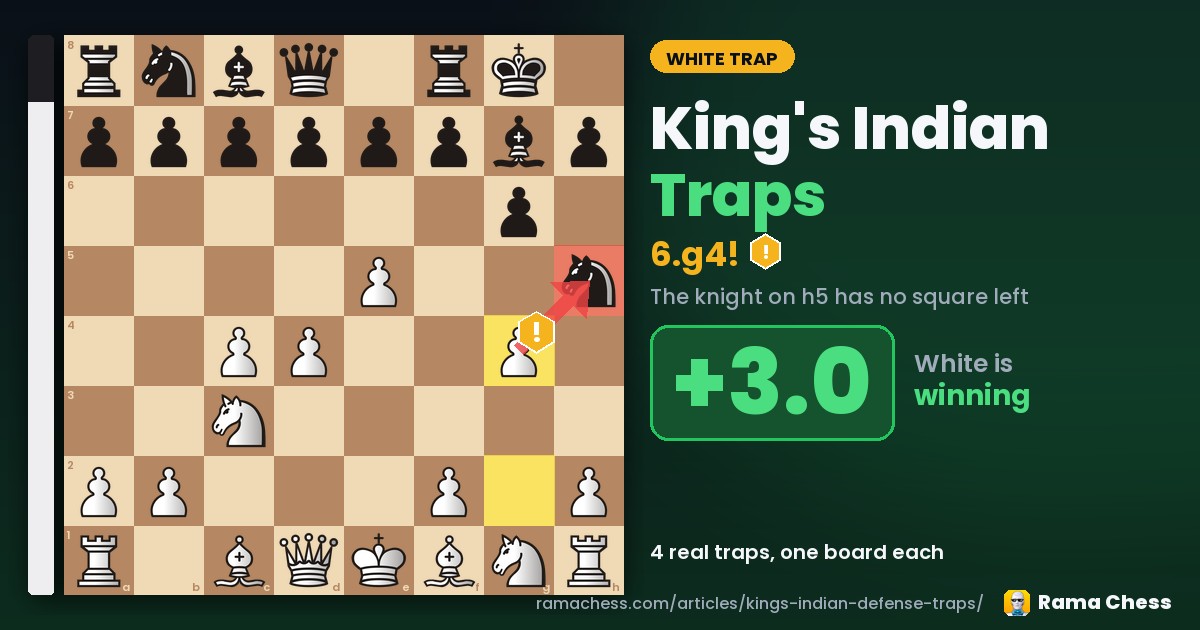
WHITE TRAPTrap 2: The Trapped Knight on h5

1.d4 Nf6 2.c4 g6 3.Nc3 Bg7 4.e4 O-O 5.e5Black falls for it with 5...Nh5?6.g4! - the knight has no square
A short trap for White. If Black castles before playing ...d6, White can push e4-e5 and chase the f6 knight. On h5 the knight has no way back, and the pawn move g4 wins it. Press Play.

How to avoid it: as Black, play 4...d6 first, so e5 can be met by ...dxe5. If White already plays 5.e5, the knight goes back to e8, never to h5.

Advertisement

King's Indian traps for Black

Both Black traps use the long diagonal of the g7 bishop. Once the centre opens, that bishop hits d4, c3 and b2, and a loose white piece can drop. After 8...Re8 and after 6...c5 Black is fine, and one careless White move loses material.

BLACK TRAPTrap 3: The e4 Pawn Trick (Classical)

1.d4 Nf6 2.c4 g6 3.Nc3 Bg7 4.e4 d6 5.Nf3 O-O 6.Be2 e5 7.O-O exd4 8.Nxd4 Re8White falls for it with 9.Bg5? and 13.Bd3??13...Rxd4 - Black wins a knight
A trap for Black in the Classical. Black takes on d4 and puts the rook on e8 against the e4 pawn. If White pins the f6 knight instead of guarding e4, Black breaks the pin with ...h6 and ...g5 and takes the pawn. Then the d4 knight is hit twice. Press Play.

How to avoid it: as White, after 8...Re8 play 9.f3 and the e4 pawn is safe. If you already lost the pawn, move the d4 knight at once with 13.Nb5: the rook and the g7 bishop both hit it.

BLACK TRAPTrap 4: The Samisch Gambit Trick (10.e5?)

1.d4 Nf6 2.c4 g6 3.Nc3 Bg7 4.e4 d6 5.f3 O-O 6.Be3 c5White falls for it with 10.e5? and 11.f4??11...Nxc5 - Black wins a bishop
A trap for Black in the Samisch. Black gives the c5 pawn for quick development. If White pushes e5 to chase the f6 knight, the knight goes to d7 and hits the c5 bishop and the e5 pawn together. Press Play.

How to avoid it: as White, after 9...Nc6 do not push e5. Play 10.Nd5 or 10.Rd1 and the game is level. If you already played 10.e5 Nd7, save the bishop first with 11.Ba3.

Where the names come from

The Averbakh Variation (5.Be2 O-O 6.Bg5) is named after the Soviet grandmaster Yuri Averbakh. The bishop on g5 is the whole point of the system: it makes the usual ...e5 break fail for a while, as Trap 1 shows.

The Samisch Variation (5.f3) is named after the German master Friedrich Samisch. The move 6...c5, giving a pawn, is called the Samisch Gambit.

The Classical Variation (5.Nf3 O-O 6.Be2 e5) is the main line of the King's Indian. The King's Indian as a whole has the ECO codes E60 to E99.

How to play the King's Indian without falling into traps

Most King's Indian traps come from two things: pins on the f6 knight, and the long diagonal of the g7 bishop. Three simple habits keep you safe:

Not every trick wins material. In the Exchange line 7.dxe5 dxe5 8.Qxd8 Rxd8, the pawn grab 9.Nxe5 is met by 9...Nxe4!, and Black wins the pawn straight back: Stockfish calls it level. It is explained in our King's Indian Defense guide, together with the plans and main lines. If you play 1.d4 as White, the Queen's Gambit traps and the London System traps are worth a look too.

King's Indian Defense Traps FAQ

What are the best King's Indian Defense traps?

Four real ones are on this page: the Averbakh pin (6.Bg5 e5? 7.dxe5 dxe5 8.Qxd8 Rxd8 9.Nd5!), the trapped knight on h5 (4...O-O 5.e5 Nh5? 6.g4!), the e4 pawn trick in the Classical, and the Samisch Gambit trick 10.e5? Nd7!. Each one is checked with Stockfish after the best defence.

Is there a King's Indian Defence trap for White?

Yes. In the Averbakh, after 6.Bg5 e5? 7.dxe5 dxe5 8.Qxd8 Rxd8 9.Nd5! White wins at least the exchange, and a whole piece after 9...c6?? 10.Nxf6+. And if Black castles early, 4...O-O 5.e5 Nh5? 6.g4! traps the knight.

What are the King's Indian traps for Black?

In the Classical, after 7.O-O exd4 8.Nxd4 Re8 9.Bg5? Black plays ...h6, ...g5 and ...Nxe4!, and wins a pawn (a knight after 13.Bd3??). In the Samisch Gambit, 10.e5? Nd7! hits the c5 bishop and the e5 pawn together.

Why does Black not play ...e5 against the Averbakh at once?

Because of the pin. After 6...e5? 7.dxe5 dxe5 8.Qxd8 Rxd8 9.Nd5 the f6 knight is pinned to the rook on d8, and c7 is hit too. Black first plays 6...c5, 6...h6 or 6...Na6.

Is the King's Indian Defense good for beginners?

The first moves are easy (Nf6, g6, Bg7, d6 and castle), but the middlegames are sharp. Learn the traps on this page and the main plans first.

Is the King's Indian Defense sound?

Yes. It is a fully sound defence that world champions such as Tal, Fischer and Kasparov played. The traps on this page come from careless moves, not from a flaw in the opening.

Set these traps in your own games

Play the King's Indian against a bot and see who walks into the Averbakh pin first.