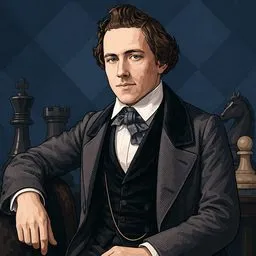
Paul Morphy (1837-1884) beat every top player he met in 1857-1859, then left serious chess. He never had an Elo rating, because ratings came a century later. So how strong was he? This page puts the historical rating estimates in one table with their sources, lists his match results, compares him with Magnus Carlsen, and lets you replay the Opera Game and two more of his best games on a board.
9 min readPublished November 2026By Surajit Paul3 boards
Play Morphy Our Paul Morphy bot plays his romantic, attacking style. Can you survive his sacrifices?
Paul Morphy never had an Elo rating. The Elo system was first used by the US Chess Federation in 1960 and by FIDE in 1970, almost a hundred years after his last serious games. Every number you see for Morphy is a historical estimate, made later from his old results.
Three well-known systems have rated him. Arpad Elo himself, the man who made the Elo system, did it in his 1978 book. Jeff Sonas did it with Chessmetrics, and Rod Edwards with the Edo ratings. They use different methods, so they give different numbers. All three agree on one thing: Morphy was the strongest player in the world in 1858 and 1859. How the Elo system works is explained in Elo rating in chess.
2812 ±46 (1860, his peak); 2802 in 1857, 2795 in 1858, 2809 in 1859
Anderssen 2627, Loewenthal 2627 (1858 list)
FIDE Elo
FIDE, from 1970
Official rating
None. He died in 1884.
-
Read 4 November 2026 from the sources linked in the first column. Elo's number is quoted by ChessBase (30 Aug 2003). The three systems use different scales, so their numbers are not the same thing as a modern FIDE rating.
Why are the numbers so different? A historical rating can only measure a player against the players of his own time. Elo used a five-year average, so the short Morphy career pulls his number down. Chessmetrics drops a player's rating when he stops playing, and Morphy played few serious games after 1859. Edo looks at every match year by year and also counts the many games he played while giving odds (a knight or a pawn) to weaker players. The safest way to read the table: Morphy was about 100 to 200 points above the next best player of his time, in every system.
How strong was Paul Morphy? His match record
He beat every leading master he played in a match. In just over a year (1857-1858) he won the First American Chess Congress and then beat the best players in London and Paris. At age 12, in New Orleans, he had already won casual games against the visiting master Johann Loewenthal.
Opponent
Where and when
Type
Morphy won
Drawn
Morphy lost
James Thompson
New York 1857 (Congress, round 1)
Knockout match
3
0
0
Alexander Meek
New York 1857 (Congress, round 2)
Knockout match
3
0
0
Theodor Lichtenhein
New York 1857 (Congress, semi-final)
Knockout match
3
1
0
Louis Paulsen
New York 1857 (Congress, final)
Knockout match
5
2
1
Johann Loewenthal
London, July-August 1858
Match
9
2
3
Daniel Harrwitz
Paris, September-October 1858
Match
5
1
2
Adolf Anderssen
Paris, December 1858
Match
7
2
2
Alfred Mongredien
Paris 1859
Match
7
1
0
Sources: Wikipedia (First American Chess Congress, Paul Morphy) and the Edo match pages. For the Loewenthal match most sources, Loewenthal himself among them, give +9 -3 =2; a few (Staunton in the Illustrated London News) give three draws. Harrwitz gave up the match after game 8.
He also played many games while giving odds, and he offered pawn-and-move odds to any player in the United States. The one famous match that never happened was against the English champion Howard Staunton. After he went home to New Orleans in 1859 he played almost no serious chess again. He died on 10 July 1884, aged 47. More players from that time are in the history of chess and our famous players hub.
Advertisement
What is the Opera Game?
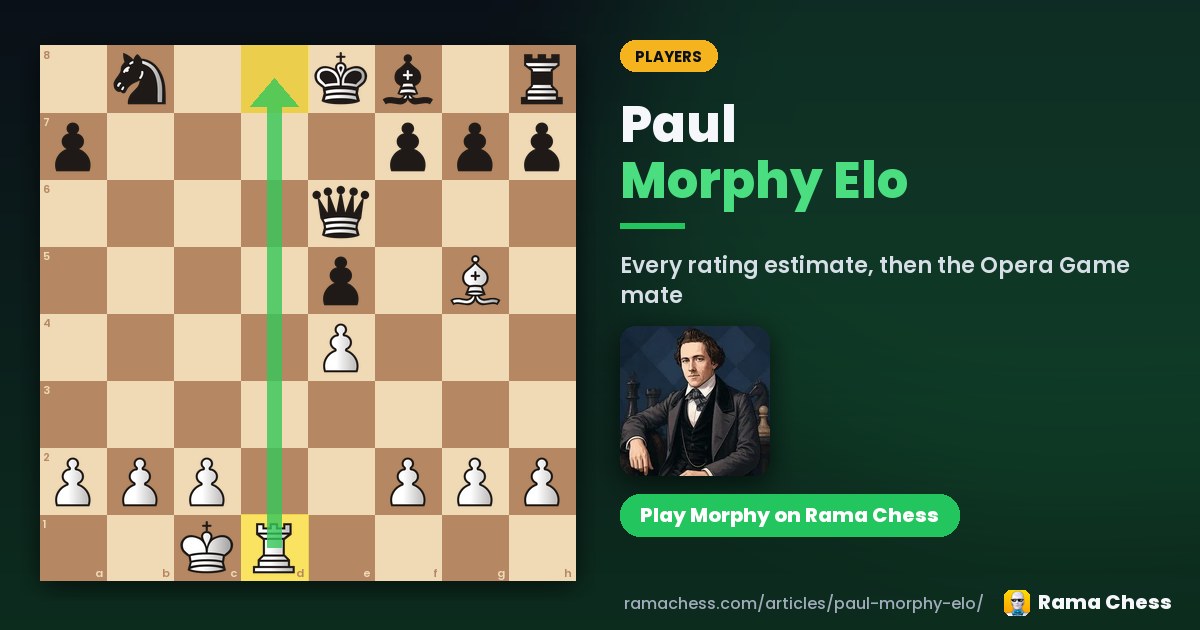
The Opera Game is a short win by Morphy in Paris in 1858, played in a box at the opera house. His opponents were the Duke of Brunswick and Count Isouard, who played Black together. Morphy (White) won in 17 moves. It is one of the most shown games in chess, because it teaches the basics so clearly: develop fast, open lines, and use every piece. It is also in our list of the most famous chess games.
Which opera was playing is not clear: Max Lange and David Lawson name The Barber of Seville, other sources name other operas.
KEY GAMEMorphy vs Duke of Brunswick and Count Isouard, Paris 1858
Paul Morphy (White) vs the Duke and the CountPhilidor Defence, 3...Bg4Queen sacrifice, mate on move 17
Press Play and watch how every white piece comes into the game, while Black's bishop on f8 and rook on h8 never move.
What to learn: Develop first, then attack. By move 12 all of Morphy's pieces were playing and two of Black's had never moved. That is why the sacrifices on b5, d7 and b8 all worked.
What happened at the 1857 American Chess Congress?
Morphy won it without losing a match. The congress ran in New York from 6 October to 10 November 1857. Sixteen top American players met in a knockout; draws did not count. Morphy beat James Thompson, Alexander Meek and Theodor Lichtenhein, then Louis Paulsen in the final with five wins, one loss and two draws. He refused the $300 first prize and took a silver service instead.
The best-known game of the final is Paulsen vs Morphy, with the queen sacrifice 17...Qxf3!!. Jump to move 17 on the board.
KEY GAMEPaulsen vs Morphy, New York 1857: 17...Qxf3!!
Louis Paulsen (White) vs Paul MorphyFour Knights Game, final of the 1857 CongressThe queen sacrifice: 17...Qxf3!!
Press Play, or jump to move 17 to see the queen sacrifice, then follow the black rook and bishops around the white king.
Key idea: A queen for a bishop is a fair trade when it strips the enemy king. After 17...Qxf3 the king on g1 had no pawn cover, and Black's rooks and bishops did the rest.
What are Paul Morphy's best games?
Most lists start with the Opera Game (1858) and Paulsen vs Morphy (1857), both on the boards above. A third favourite is his win against Henry Bird in London, 1858, with the rook sacrifice 17...Rxf2 and the quiet queen move 18...Qa3!!. Strong players still argue whether the rook sacrifice was fully correct, and Stockfish today is not sure either. It is still a great example of how Morphy opened the enemy king.
BEST GAMEBird vs Morphy, London 1858: 17...Rxf2!? and 18...Qa3!!
Henry Bird (White) vs Paul MorphyPhilidor Defence with 3...f5Rook sacrifice, then 18...Qa3!!
Jump to move 17 to see the rook sacrifice. Then watch the black queen walk to a3, a2 and a1 next to the white king.
Key idea: When the enemy king castles long, the a- and b-files are the way in. Morphy gave a rook to open them, and Bird's one wrong king move (22.Kb2?) was enough to lose.
Paul Morphy vs Magnus Carlsen: who was stronger?
No rating can answer this fairly, because the two never played the same opponents. Magnus Carlsen's peak of 2882 (FIDE, May 2014) is a real Elo rating, earned against modern grandmasters. Morphy's numbers in the table are estimates on other scales, measured against the players of the 1850s.
Distance from the rest. Both were far ahead of their rivals. Morphy's lead over Anderssen and Loewenthal was about 100 to 200 points in the historical systems.
Knowledge. Carlsen learned from 170 years of games, books and engines. In 1858 there was no opening theory as we know it, and many ideas Morphy used (fast development, open lines for the rooks) were only written down later.
Career. Morphy played top-level chess for about two years. Carlsen has been world number one since 2011.
Computer studies. The best-known engine study of the great players (Guid and Bratko, 2006) looked only at official world champions from Steinitz on, so Morphy is not in it. We found no published engine study that ranks Morphy against Carlsen.
So the fair answer: Carlsen would win a match today because he knows far more chess; Morphy, for his time, was just as dominant. For a modern comparison of the same kind see Magnus Carlsen vs Bobby Fischer.
Was Paul Morphy the best chess player of all time?
He was clearly the best of his own time; whether he was the best ever is an opinion. Chessmetrics has him as world number one in 39 different months (September 1858 to November 1861), and Edo has him first every year from 1849 to 1867.
Great players disagree about the rest. Bobby Fischer put Morphy first in his 1964 list of the ten greatest masters and called him "perhaps the most accurate player who ever lived". Viswanathan Anand named him in his top ten (2000), and Hikaru Nakamura put him tenth in his 2021 list. Larry Kaufman (2023) wrote that Morphy "might have rivaled Fischer for the top spot if we could properly correct for these factors". There was no official world championship in his day: the first one was Steinitz vs Zukertort in 1886, two years after Morphy died. See every official number one in world number 1 chess players.
Paul Morphy Elo FAQ
What was Paul Morphy's Elo rating?
He never had an official one; FIDE ratings started in 1970. Historical estimates: 2690 in Arpad Elo's 1978 book (best five-year average), 2743 at Chessmetrics (June 1859, world No. 1) and 2812 in the Edo ratings (1860).
How strong was Paul Morphy?
He beat every top player he met in a match: Paulsen (1857), Loewenthal and Harrwitz (1858) and Anderssen (December 1858, seven wins, two draws, two losses). Rating systems put him 100 to 200 points above the next best player of his time.
Paul Morphy vs Magnus Carlsen: who was stronger?
They cannot be measured on one scale. Carlsen's 2882 (May 2014) is a real FIDE rating; Morphy's numbers are estimates against 1850s players. Carlsen knows far more chess, while Morphy was just as far ahead of the players of his time.
What is the Opera Game?
A casual game Morphy won in 17 moves in Paris in 1858, in a box at the opera house, against the Duke of Brunswick and Count Isouard. It ends with a queen sacrifice and 17.Rd8 mate.
Was Paul Morphy a world champion?
Not officially. The first official world championship match was Steinitz vs Zukertort in 1886, after Morphy's death. After his 1858 wins many people saw him as the best player in the world.
Why did Paul Morphy stop playing chess?
After he came home to New Orleans in 1859 he played almost no serious chess again and tried to work as a lawyer. He died on 10 July 1884, aged 47.
Play like Morphy
Develop fast and open lines: try it against a bot, or load any Morphy game into the Analyser.