Scotch Game Traps: 4 Real Traps for White and Black
The Scotch Game, 1.e4 e5 2.Nf3 Nc6 3.d4, opens the centre at once, so the traps come early. This page has four real traps from the Scotch Game and the Scotch Gambit. Two are for White: a queen fork in the Max Lange Attack and a bishop sacrifice on f7. Two are for Black: a mate on f2 and a check on the e-file. Each trap is on its own board with the side lines, a Stockfish evaluation and a short "how to avoid it".
8 min readPublished November 2026By Surajit Paul4 traps · 4 boards
There is no Scotch video on our channel yet, so here is our general opening traps video: Stockfish 18 shows six traps every club player should know. Then replay the four Scotch traps below at your own speed.
Stockfish 18 Shares 6 Chess Opening Traps That You Must Know | Chess Opening
How to use the boards: press ▶ Play or tap a move. The buttons above each board switch to the side lines (what if the other player plays something else). Arrows show the threats; draw your own with a right-click drag. The numbers are Stockfish 18 evaluations: + means White is better, - means Black is better.
Scotch traps for White
Both White traps come from the Scotch Gambit, 4.Bc4, where White develops before taking the pawn back. Each one punishes a natural move by Black. They are the best Scotch Gambit traps for White.
WHITE TRAPTrap 1: The Max Lange Attack trap (Scotch Gambit)
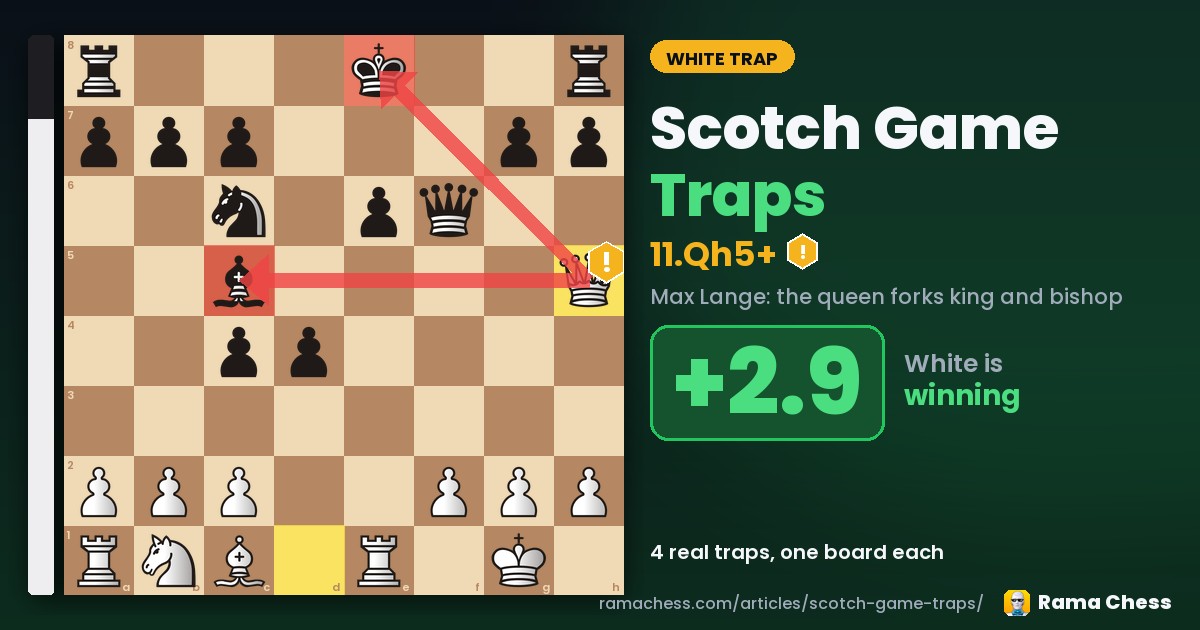
1.e4 e5 2.Nf3 Nc6 3.d4 exd4 4.Bc4 Nf6 5.O-O Bc5 6.e5Black falls for it with 9...Qxf6?11.Qh5+ - the queen forks king and bishop
In the Max Lange Attack the knight jumps to g5 and hits the bishop on e6. Taking the f6 pawn with the queen looks natural, but White gives the knight on e6 and checks on h5, and the bishop on c5 falls. Press Play, then try the side lines.
How to avoid it: as Black, after 9.Ng5 guard the e6 bishop with 9...Qd5 (or play 9...g6). And after 8.Re1+ never block with 8...Be7?? - the pawn on f6 takes it.
WHITE TRAPTrap 2: The Bxf7+ and Qd5+ trick (Scotch Gambit)
1.e4 e5 2.Nf3 Nc6 3.d4 exd4 4.Bc4 Bc5 5.c3Black falls for it with 5...dxc3?7.Qd5+ - the bishop on c5 falls
White offers a second pawn with 5.c3. If Black takes it, the bishop on c5 has no guard. White gives the c4 bishop on f7, checks on d5 and wins the bishop back, and the black king can never castle. Two wrong king moves even lose to mate. Press Play.
How to avoid it: as Black, after 5.c3 do not take the second pawn. Play 5...Nf6 (level game) or 5...d3. If you already took on c3 and White checks on d5, the king goes to e8 or f8, never to g6 or f6.
Advertisement
Scotch Game traps for Black
One Black trap is in the main Scotch Game, 4.Nxd4, and one is in the Scotch Gambit. In both, Black hits a weak square near the white king: f2, or the open e-file.
BLACK TRAPTrap 3: The ...Qf6 mate trap (Classical Variation)
1.e4 e5 2.Nf3 Nc6 3.d4 exd4 4.Nxd4 Bc5 5.Nxc6White falls for it with 6.Nc3??6...Qxf2# - checkmate
A trap for Black in the main Scotch Game. When White takes on c6, Black does not take back. The queen goes to f6 and, with the bishop on c5, hits f2. If White plays a normal developing move, it is mate on move 6. Press Play.
How to avoid it: as White, after 5.Nxc6 Qf6 guard f2 first: 6.Qf3 or 6.Qd2. Both keep the game level. Or do not take on c6 at all: 5.Be3 and 5.Nb3 are the main moves.
BLACK TRAPTrap 4: The ...Qe7+ check against 5.Ng5 (Scotch Gambit)
1.e4 e5 2.Nf3 Nc6 3.d4 exd4 4.Bc4 Nf6 5.Ng5White falls for it with 5.Ng5?!6...Qe7+ - White cannot castle
A trap for Black in the Scotch Gambit. White attacks f7 with the knight and bishop, like in the Fried Liver Attack. But with the d4 pawn gone, Black answers ...d5 and then ...Qe7+ on the open e-file. White loses the right to castle, then the c4 bishop. Press Play.
How to avoid it: as White, after 4...Nf6 play 5.e5 or 5.O-O, not 5.Ng5. If you are already in it, 7.Kf1 is the best try; 7.Be2 loses a pawn.
Where the Scotch Game gets its name
The Scotch Game takes its name from a correspondence match in 1824 between Edinburgh and London. It was popular in the 19th century, then went out of fashion, until Garry Kasparov and other top players brought it back in the 1990s.
The Scotch Gambit is the move 4.Bc4: White develops the bishop and leaves the d4 pawn for later. With castling and e5 it often turns into the Max Lange Attack (Trap 1). Two other big Scotch lines carry names too: the Steinitz Variation4...Qh4, made popular by Wilhelm Steinitz, and the Mieses Variation4...Nf6 5.Nxc6 bxc6 6.e5, which Jacques Mieses played again and again at Hastings 1895.
How to play the Scotch without falling into traps
The centre opens on move 3, so loose pieces and the squares f2 and f7 matter from the start. Three simple habits keep you safe:
Look at f2 and f7 every move. A bishop on c5 or c4 and a queen on f6 or h5 is all it takes. In Trap 3 one quiet move lets ...Qxf2 mate.
Count the guards on your bishops. In Traps 1 and 2 the bishop on c5 has no guard, and a check with a fork wins it.
Do not grab a second gambit pawn when your king is still in the centre. 5...dxc3? in Trap 2 and 9...Qxf6? in Trap 1 are both greedy moves.
For White, the Max Lange Attack trap: after 9.Ng5 Qxf6? 10.Nxe6 fxe6 11.Qh5+ the queen forks the king and the bishop on c5, and White wins a piece (Stockfish +3.1). For Black, the ...Qf6 trap: 4...Bc5 5.Nxc6 Qf6 and any careless move like 6.Nc3?? allows 6...Qxf2 mate.
Is there a Scotch Gambit trap for White?
Yes, two in this article. In the Max Lange Attack, 9...Qxf6? loses a piece to 10.Nxe6 and 11.Qh5+. After 4...Bc5 5.c3 dxc3? White plays 6.Bxf7+ Kxf7 7.Qd5+ and wins the bishop back; 7...Kg6?? even loses to 8.Qf5 mate.
What are the Scotch Game traps for Black?
The ...Qf6 mate trap (4.Nxd4 Bc5 5.Nxc6 Qf6!, threat ...Qxf2 mate) and the ...Qe7+ check against 5.Ng5 in the Scotch Gambit (5...d5 6.exd5 Qe7+ and White cannot castle).
Is the Scotch Gambit sound?
Yes. After 4.Bc4 Nf6, both 5.e5 and 5.O-O keep the game level (Stockfish 0.0 to +0.1). It is a gambit for quick development, not a forced win. Only the early 5.Ng5 is a mistake.
Why is it called the Scotch Game?
It is named after a correspondence match between Edinburgh and London in 1824. Garry Kasparov and other top players brought it back in the 1990s.
How do I avoid the ...Qf6 trap as White?
After 4...Bc5 5.Nxc6 Qf6, guard f2 at once with 6.Qf3 or 6.Qd2; Stockfish calls both level. You can also avoid it with 5.Be3 or 5.Nb3 instead of taking on c6.
Set these traps in your own games
Play the Scotch against a bot and see who leaves f2 or f7 without a guard first.